
The global agricultural landscape in 2026 is defined by a rapid shift toward sustainable sourcing and high-value commodities. Within this evolving framework, Cameroon cocoa beans international trade has emerged as a cornerstone of the West African economic recovery. As global chocolate brands seek more resilient supply chains, Cameroon’s unique “Red Cacao” has transitioned from a niche specialty to a primary industrial asset. For procurement officers and commodity traders, mastering the nuances of this market is essential for long-term success.
Noumedem Global Trade (Noumedem Entreprise) stands at the forefront of this evolution, facilitating a transparent and efficient gateway for all actors involved in the Cameroon cocoa beans international trade.
Market Valuation: April 2026 Pricing Dynamics
As of April 7, 2026, the Cameroon cocoa beans international trade is navigating a period of price normalization following the historic peaks of previous seasons. Current official data from the National Cocoa and Coffee Board (NCCB) shows an FOB (Free On Board) price in Douala stabilized at 1,753 FCFA/kg. While this represents a correction from the extreme highs of 2024, the intrinsic value of Cameroonian beans remains high due to their superior fat content (52-54%), which offers a better soluble yield for industrial grinders.
The Impact of EUDR on Global Trade Flows
The most significant disruption in the Cameroon cocoa beans international trade in 2026 is the full implementation of the European Union Deforestation Regulation (EUDR). With over 80% of Cameroon’s production traditionally destined for the EU, compliance is no longer optional. Noumedem Global Trade has led the sector by georeferencing over 90% of its partner plantations. By providing full GPS traceability, we ensure that our shipments remain fluid within the Cameroon cocoa beans international trade corridors, protecting our buyers from the risk of port rejections.
Regional Production Powerhouses: Sourcing Basins
The strength of the Cameroon cocoa beans international trade lies in its geographical diversity. The Center Region, particularly the Mbam-et-Kim basin, continues to produce nearly 45% of the national volume. However, the volcanic soils of the Littoral and Western regions, including Melong, are gaining traction for their “Fine Flavor” characteristics. These regions provide the premium lots that command a higher premium in the Cameroon cocoa beans international trade, often bypassing standard commodity exchange fluctuations.

Infrastructure and Logistics: The Douala-Kribi Corridor
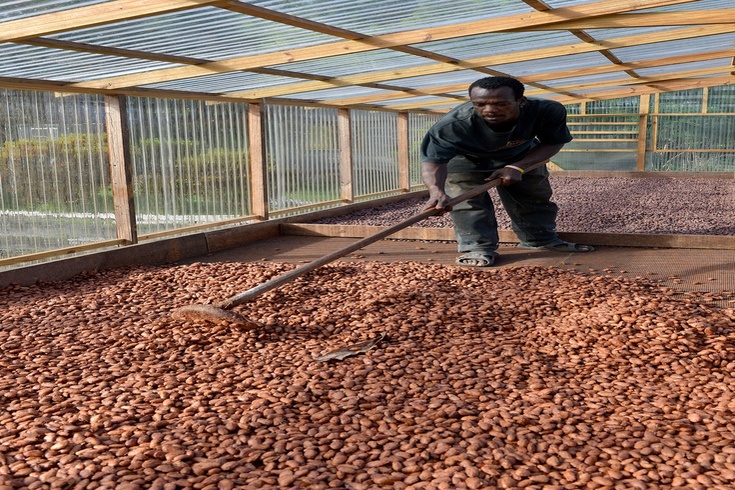
Logistical excellence is a prerequisite for any firm operating in the Cameroon cocoa beans international trade. The modernization of the Douala International Terminal and the expansion of the Kribi Deep-Sea Port have collectively reduced vessel loading times by 18% in 2026. At Noumedem Entreprise, we leverage this improved infrastructure to ensure that our “Red Cacao” reaches international ports with its moisture content perfectly stabilized at 7.5%, a critical factor for maintaining quality during long maritime transits.
Technical Quality: The Competitive Edge
In the competitive world of the Cameroon cocoa beans international trade, technical specifications are the primary currency. Cameroonian beans are famous for their high melting point cocoa butter, which is essential for chocolate stability in warmer climates. By implementing a standardized 6-day fermentation protocol, we ensure that our beans meet the rigorous “Grade 1” standards required for high-end Cameroon cocoa beans international trade contracts, ensuring zero smoke-taint and a uniform bean count.
The Shift Toward Domestic Primary Processing
A notable trend in the Cameroon cocoa beans international trade this year is the rise of local processing. Cameroon now processes over 32% of its crop domestically (over 100,000 metric tons). This industrialization adds value to the export chain, moving from raw beans to cocoa mass, butter, and powder. This shift provides international buyers with a more diverse range of products to source within the Cameroon cocoa beans international trade ecosystem, reducing their exposure to the volatility of raw commodity markets.
Sustainability and Ethical Sourcing
Ethics are now a core component of the Cameroon cocoa beans international trade. Modern buyers demand more than just a product; they demand a story of impact. Through our “Direct Trade” model, Noumedem Global Trade ensures that premiums paid by international partners reach the smallholder farmers. This ethical loop is vital for the long-term sustainability of the Cameroon cocoa beans international trade, ensuring that the next generation of farmers remains committed to high-quality cacao production.
Future Outlook: Projections for Q4 2026
As we look toward the final quarter of 2026, analysts predict a 12% increase in demand for certified “sustainable” cocoa. For importers, securing long-term contracts now is a strategic hedge against the predicted supply tightening. Noumedem Global Trade remains your most reliable partner in this journey, offering the expertise and transparency needed to excel in the Cameroon cocoa beans international trade.
Conclusion: Navigating Excellence in 2026
The Cameroon cocoa beans international trade represents a unique intersection of volcanic terroir, heritage farming, and 21st-century digital traceability. By choosing a partner who masters these three elements, international buyers can ensure their supply chain is not only profitable but also future-proof. Partner with Noumedem Global Trade and secure the best of Africa’s Red Cacao today.